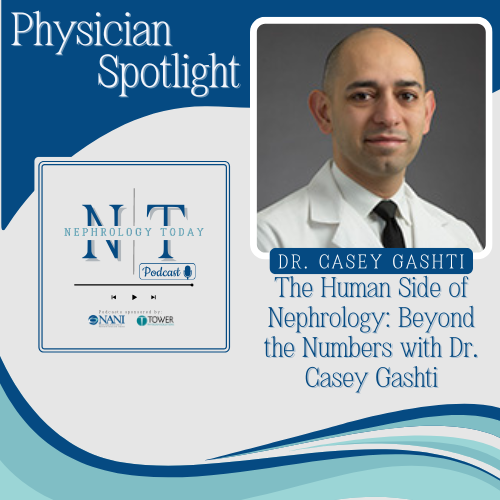
In a recent episode of the Nephrology Today podcast, NANI’s own Dr. Casey Gashti, board-certified
nephrologist and Associate Professor at Rush University Medical Center, shared a profound perspective on
kidney care. His insights go beyond lab values and clinical algorithms, reminding us that great nephrology is
not just about science—it’s about philosophy, vulnerability, and deep human connection.
The Allure of a Balanced Specialty
Dr. Gashti, whose father was also a nephrologist, was drawn to the field for its unique sense of balance. He
describes nephrology as having a “very nice balance of acuity and chronicity,” offering both inpatient and
outpatient care. This diversity keeps his work dynamic, intellectually stimulating, and deeply rewarding.
He also points to the exciting growth in nephrology, including advancements in transplantation,
onco-nephrology, and emerging therapeutics. His passion for lifelong learning is reflected in his dual role as an
educator, which pushes him to stay current not only on the science but also on evolving teaching
methodologies.
Debunking Nephrology Misconceptions
Many medical residents shy away from nephrology because of misconceptions. Dr. Gashti addresses these
directly:
● “It’s abstract and math-heavy.” When taught well, he explains, nephrology is not about equations—it’s “the story of physiology in motion.”
● “It lacks procedural excitement.” Far from it. Decisions around dialysis, transplantation, and conservative management are among the most impactful a patient will ever face. These are life-altering moments that demand both intellect and empathy.
● “It’s hard to balance work and life.” Acknowledging these concerns, Dr. Gashti shares that his 18-year career has been both gratifying and sustainable because he intentionally pursues balance—professionally and personally.
Evidence as a Compass, Not a Script
Perhaps the most illuminating part of Dr. Gashti’s philosophy lies in his approach to evidence-based medicine. To him, evidence is a compass, not a script.
He emphasizes shared decision-making, especially for elderly or frail patients where data alone may not
provide clear guidance. His approach integrates clinical evidence with a patient’s goals and values:
“I ask my patients, ‘What are your goals? What does quality of life mean for you?’ When they answer those questions, it not only informs my approach but helps them reflect on what truly matters to them.”
This human-centered approach—where ethics and empathy are as vital as analytics—is what defines NANI’s
model of compassionate, comprehensive care.
Teaching the Humanity of Medicine
Dr. Gashti’s background in both chemistry and religion/philosophy shapes his mentoring style. He calls it “constructive discomfort”—pushing residents just beyond their comfort zones, but within a safety net of support.
His teaching philosophy rests on three core principles:
● Modeling Vulnerability: He shares his own uncertainties, showing that medicine often lives in the gray areas of ethics and judgment.
● Listening Deeply: He reminds residents that patients often reveal key clinical insights simply by being heard.
● Connection Over Transaction: Mentorship, to him, is a two-way street—where teachers and learners grow together.
For young physicians seeking a field that values both clinical mastery and human reflection, Dr. Gashti’s advice is to protect their curiosity and make time for introspection.
A Culture of Support
Dr. Gashti concludes by expressing pride in NANI for supporting the Nephrology Today podcast and amplifying
physician voices. He emphasizes that NANI understands its physicians are both scientists and people—navigating the profound human dimensions of care.
This episode is a testament to the kind of thoughtful, balanced, and deeply human medical practice that NANI embodies—one that’s as scientifically rigorous as it is ethically profound.
Are you a healthcare professional seeking a career that values both medical excellence and meaningful connection?
Learn more about career opportunities at NANI and join a team dedicated to truly comprehensive,
compassionate kidney care. Listen to the Podcast on Spotify